4620 East Douglas, Suite 100 Wichita, KS 67208

What Is Dental Bonding? A Simple Cosmetic Solution for Small Smile Flaws

A chipped edge. A slight gap. A tooth that’s a shade off from the rest. These are small things, but they can quietly affect how confident you feel when you smile.
Here’s the good news: not every cosmetic concern needs veneers, crowns, or months of treatment. Sometimes, one appointment and a tooth-colored resin is all it takes.
If you’ve been wondering whether your smile issue is “worth fixing,” this blog is for you. We’re talking about dental bonding — what it is, what it can do, and whether it might be the right fit for you.
So, What Exactly Is Dental Bonding?
It remains one of the simplest cosmetic dentistry treatments. The resin, colored to match the tooth, is applied directly to it, then shaped to correct the imperfection, and finally hardened by exposing it to a curing light specifically designed for this process.
Dental bonding in Wichita, KS, is now the most preferred treatment among patients because it offers more visible, natural-looking results and is less time-consuming than other, more complex treatments. Just Imagine. No lab. No waiting weeks. In most cases, it’s done in a single visit.
What Dental Bonding Can Actually Do?
One can hardly believe how versatile this treatment really is. Here is a description of the most common issues it solves:
- Chipped or cracked teeth — bonding a chipped tooth is one of the most frequent uses; it restores the shape naturally
- Gaps between teeth — small spaces can be closed without braces
- Discoloration — teeth that don’t respond well to whitening
- Slightly misshapen teeth — teeth that look too small, uneven, or irregular
- Exposed tooth roots — when gums recede, bonding can cover and protect sensitive areas
- Worn-down edges — from grinding or natural wear over time
It isn’t compatible with orthodontics for cases of severe misalignment, nor does it suit teeth that have been excessively worn down. However, dental bonding can fix a wide range of everyday cosmetic concerns and is quite practical.
The Procedure: Simple and Straightforward
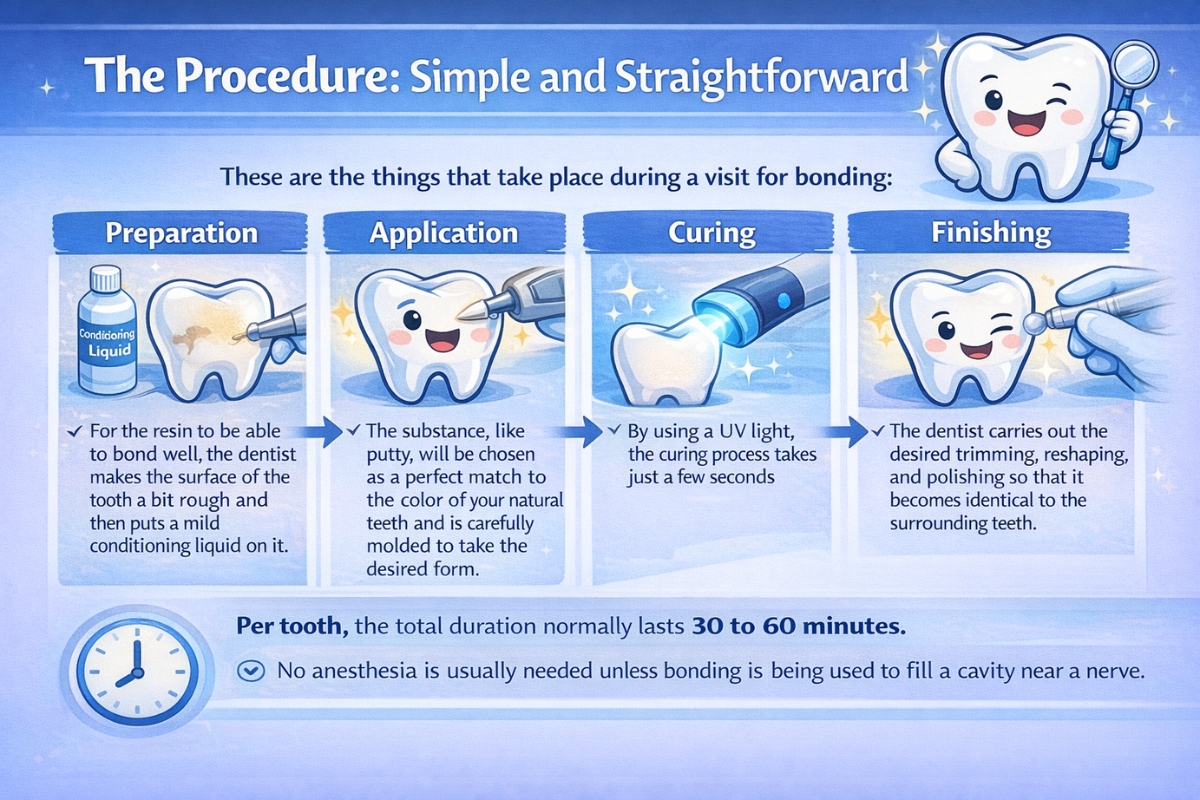
These are the things that take place during a visit for bonding:
- Preparation: For the resin to be able to bond well, the dentist makes the surface of the tooth a bit rough and then puts a mild conditioning liquid on it.
- Application: The substance, like putty, will be chosen as a perfect match to the color of your natural teeth and is carefully molded to take the desired form.
- Curing: By using a UV light, the curing process takes just a few seconds.
- Finishing: The dentist carries out the desired trimming, reshaping, and polishing so that it becomes identical to the surrounding teeth.
Per tooth, the total duration normally lasts 30 to 60 minutes. No anesthesia is usually needed unless bonding is being used to fill a cavity near a nerve.
How Long Does It Last?
Bonding can last 3 to 10 years with proper oral care; if not, small touch-ups can be made. In this way, a quick, cost-effective procedure is advantageous in the long term. To keep your bonding lasting as long as possible:
- Don’t bite your nails, chew ice, or use your teeth as tools.
- Keep your teeth away from coffee, tea, and red wine. Over time, the resin can become discolored.
- Brush your teeth twice a day, and always make it a point to visit your dentist for regular cleanings.
If you are a person with the habit of grinding teeth, don’t hesitate to tell your dentist about it.
Is Dental Bonding Right for You?
Dental bonding in Wichita, KS, is a go-to solution for minor cosmetic touch-ups in patients with healthy teeth. It’s a good option for those who:
- Are bothered by a small chip or crack
- Feel self-conscious about a gap between teeth
- Have a tooth that looks a little bit “off” from the others
- Want a quick, same-day fix without long-term commitment
If your issue is more about significant structural concerns or bite problems, your dentist will have other treatment recommendations. However, for patients in Wichita, from Old Town to the East Side and beyond, bonding often offers the fastest route to a more symmetrical, natural-looking smile.
Cost and What to Expect
Bonding is one of the quick cosmetic dental procedures. While the cost will vary based on how many teeth need treatment and the scope of work, it’s considerably less expensive than veneers or crowns.
Most dentists include cosmetic bonding in their standard cosmetic consultations. You should check what your insurance plan covers, as many carriers will pay for bonding when it’s performed to correct a structural problem, such as a chip.
Your Smile Deserves Attention — Even for “Small” Things
Sometimes, it’s those little imperfections that stick with you and occupy your thoughts. Dental bonding in Wichita, KS, is a solution for situations when your problem isn’t severe enough to warrant a major procedure, but you’d still like to address it.
If that’s your situation, you shouldn’t rule out exploring bonding as an option. And at Pauly Dental, we can help you determine whether it’s the right fit.
Ready to See If Bonding Is Right for You?
Book a consultation with Pauly Dental. Whether you have a chipped tooth, a gap you’ve always wanted closed, or just a question about your smile, the team is ready to walk you through your options with no pressure and no complicated process.
Serving patients throughout Wichita and the surrounding areas. Schedule your visit today at Pauly Dental
Common Questions About Dental Bonding
- Does dental bonding hurt?
Generally, no. Most bonding procedures don’t require anesthesia. You may feel mild sensitivity for a day or two after, but discomfort is minimal.
- Can bonding fix a chipped front tooth?
Yes, bonding a chipped front tooth is one of the most common and effective uses of this treatment. The results look very natural.
- How is bonding different from veneers?
Veneers are porcelain shells made in a lab and bonded over the front of the tooth. Bonding uses resin applied directly in the office. Bonding is faster and more affordable; veneers tend to last longer and resist staining better.
- Will bonded teeth look natural?
Yes. The resin is color-matched to your natural teeth, and a skilled dentist will shape and polish it to blend in seamlessly.
- Can bonding be whitened later?
No — composite resin doesn’t respond to whitening treatments. If you’re planning to whiten your teeth, do it before bonding so the resin can be matched to your new shade.